
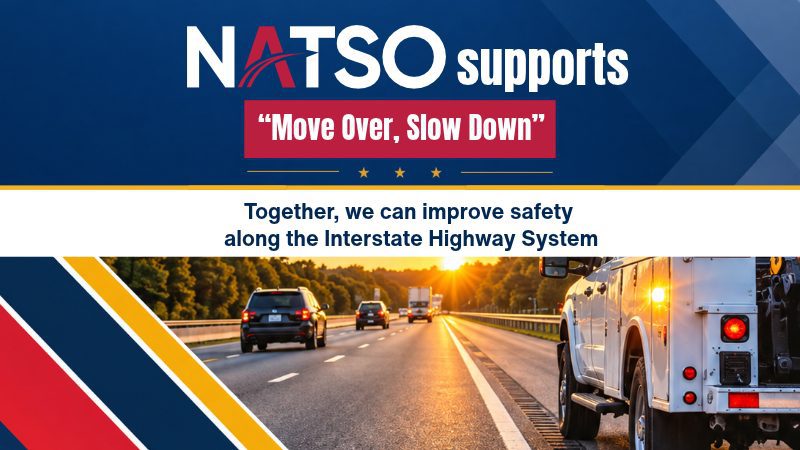
Support a National “Move Over, Slow Down” Standard
Although almost every state has some version of a “Move Over, Slow Down” law, requiring drivers to change lanes or significantly reduce speed when approaching stopped emergency vehicles, tow trucks, and/or vehicles with flashing hazard lights, there is no consistent or uniform understanding of those rules across state lines. In fact, data shows that drivers are often unaware that these laws are on the books. The consequences of these inconsistencies are measured in lives lost. A uniform, national “Move Over, Slow Down” standard, coupled with driver education requirements and a public awareness campaign, would create a much-needed foundation for improving safety along the Interstate Highway System.
NATSO Thinks U.S. DOT Should Implement the Following:
1. Establish a Uniform National “Move Over, Slow Down” Standard.
Require states to adopt a uniform standard that directs drivers approaching a stopped emergency vehicle, law enforcement vehicle, tow truck, maintenance vehicle, or utility vehicle, provided such vehicle is displaying flashing or oscillating lights, to change lanes to vacate the lane closest to the stopped vehicle. If a lane change cannot be made safely, drivers should reduce to a speed that is reasonable and prudent under the circumstances.
2. Expand Public Awareness and Strengthen Driver Education.
States should incorporate “Move Over, Slow Down” principles into the driver education curriculum, including the online practice exams, road skills tests, and knowledge exams. For expanded public awareness, states should be required to place highway signage on major roadways and other appropriate locations within the state to inform motorists of the “Move Over, Slow Down” requirements and their obligations under it. States should also partner with existing work zone safety outreach programs and other cooperative efforts to educate drivers.
3. Use Federal Highway Funding to Encourage State Compliance.
DOT should encourage Congress to make the apportionment of highway funds conditional on state compliance. States that fail to enact and enforce compliant laws should have 10 percent of their highway funds withheld, transitioning to 8 percent for subsequent years. These withheld funds would be restored once the state becomes compliant.
4. Require Enforcement and Reporting.
Compliant states should impose a civil penalty for violations and submit annual reports to DOT detailing the number of violations detected and penalties assessed and collected.
5. Improve Data Collection on Roadside Safety.
States should improve the collection and reporting of roadside crashes to facilitate the identification of trends and evaluate the effectiveness of a national “Move Over, Slow Down” standard.
Roadside Safety by the Numbers
36
66%
58%
Emergency responders were killed after being struck by vehicles while working roadway incidents in 2025. Three were roadside service technicians. Eleven were tow truck operators.
Only 66% of drivers believe their state’s law requires special action when passing a stopped police car. Source: AAA
Only 55% of drivers believe their state’s law requires special action when passing a stopped tow truck. Source: AAA
Tiffany Wlazlowski Neuman
Vice President, Public Affairs
twlazlowski@natso.com
(202)-365-9459