Mobile Payments Reshape the Competitive Landscape for Travel Centers

Traditionally, professional drivers haven’t had as many options to pay at the pump, but that is changing as new payment platforms gain traction across the trucking industry. These new platforms are not only increasing efficiency for drivers but also reshaping how truck stops and travel centers compete and forcing them to rethink how they attract and retain fueling customers.
Rising Competition and New Challenges
Competition for diesel gallons at truck stops and travel centers has increased, and operators now face the growing challenge of navigating multiple payment platforms, including the many mobile payment platforms that are rapidly becoming the norm across both consumer and commercial fueling.
New payment platforms offer drivers increased convenience and discounts and can help direct trucks toward specific locations, but the benefits for operators aren’t always straightforward or easy to calculate.
“A lot of times, I see truck stop operators asking how to use these platforms best because you need them to pull in gallons, but you need to do it in a profitable way,” said Peter Rasmussen, CEO and founder of Convenience and Energy Advisors. “Overall, it can be extremely confusing in many cases.”
A New Way to Compete
Traditionally, fuel prices were based on nearby competitors and negotiated agreements, but the process has gotten more complex. “Historically and until very recently, fleets and drivers relied on high-rise signs and eyesight to recognize known truck stops when choosing where to fuel,” said Jeremie Myhren, cofounder and CIO of ONRAMP. “Starting around 2020, several new solutions entered the truck stop diesel payments market—ONRAMP included—that give drivers fuel station discovery tools in their apps.”
ONRAMP, for example, enables drivers to discover truck stops, see the price with any applicable discounts, and use the app to plan their route and navigate to truck stops.
As a result, operators have to change the way they market fuel.
“Now we can’t just enjoy having a good location with good highway visibility to drive traffic. We need to be on the maps in the apps the drivers will use,” Myhren said. “If we aren’t, we’re effectively invisible to the driver and are simply not an option.”
Relay Payments, a secure, cashless and cardless payment platform, also features locations in its app. Drivers can search or browse the location directory to find participating truck stops, parking facilities and other services. With Relay, carriers fund driver accounts digitally and drivers pay through the app. Relay can integrate with SmartDesk through integrations or provide tablets for locations with older systems.
Chris Oliver, chief marketing officer for Trucker Path, said he has seen tremendous growth in the number of drivers who use mobile payment solutions embedded in the Trucker Path app. Truck stops can become part of the Trucker Path fuel network, which enables them to appear in the app, share deals and communicate with drivers.
“In our case, we give proprietors the ability to add special deals or promotions as well,” Oliver said. “You have the opportunity to deliver a message to a very targeted and engaged audience on your premises.”
Most Trucker Path users have a wallet established in the app. “The system is geofenced, so it knows when they arrive. “We validate that it’s them and give them that code they punch into the pump,” Oliver said.
Driver Convenience
With mobile payment platforms, transactions are faster, more secure and often tied to discounts. They also eliminate the need for drivers to go inside to complete a transaction at the fuel desk.
“Giving the driver a digital fueling experience that is comparable to what they are accustomed to with a plastic card but without the card is key to keeping the drivers happy, rested and efficient,” Myhren said.
Speed and efficiency are critical to professional drivers who are subject to hours-of-service limits that mandate how long they’re allowed to drive. “Having to go stand in line to prepay for diesel, then go back out and fuel, then go back in and get a receipt, etc., really impairs that break and can make or break tight pickup and delivery windows,” Myhren said.
Cardless transactions also increase overall convenience. “It is one less thing to have to worry about that can make a driver’s day easier. Think about the human side of what friction means for customers,” said Meghann Erhart, executive vice president for Relay Payments.
Increased Payment Options
Myhren said there is a class of new fleet payment networks, issuers and solutions in the market. “We’ve seen many high-profile operators in the space as well as true independent operators adopting these new payment methods,” he explained.
After an initial start with somewhat problematic, non-integrated solutions, such as tablets, most new payment solutions now have pump and point-of-sale integration solutions in place. Myhren said this creates an easier point of entry for operators looking to maintain control and simplicity while offering the payment methods drivers need in order to fuel with them.
From a site operator’s perspective, tablets have several negatives, including an avenue for loss and increased exposure due to a lack of controls since the tablet isn’t integrated with any POS system. “Cashiers can and do make entry errors when manually ringing things between the tablet and the POS,” Myhren said.
Tablets also create another user interface that cashiers must be trained on and become familiar with, and they have the potential to create a negative customer interaction if a cashier is unfamiliar with a tablet. They are also another device that requires power, software updates and WiFi connectivity that must be supported and managed by the operator.
While solutions have gotten easier to deploy, operators now have to juggle several digital platforms simultaneously, each pulling gallons in different ways, which means it is important for them to look at the different platforms to maximize volume.
“Accepting new payment options and appearing in their networks allows operators to keep their existing customers as they move to these new payments and discovery solutions, as well as become visible to customers who maybe never considered them before using the app that shows the pin on their route,” Myhren said.
Rasmussen said that, in addition to examining the fuel margin, it is also important to consider whether a driver who stopped due to the payment solution came inside to make a purchase. “There are so many different layers to it that you need the time to dissect and review it,” he said.
Given the growth in the mobile payment market, it can be a challenge for operators to find the time and resources to explore all of the options. “You can get started one at a time based on what you believe is probably the largest piece of the pie,” Rasmussen said, adding that while he doesn’t endorse any particular system, he would start with one of the larger players and then go through the rest one at a time.
Some operators choose not to take part with any of them and say they will be fine without it. “Maybe that’s the right decision, maybe it’s not or maybe you should at least be on it with the margin parity that you would like. Then, you’re part of the digital opportunity of where trucks can ultimately fuel,” Rasmussen said.
While some operators worry that mobile payments mean fewer drivers coming inside the store, Oliver said it is also an opportunity. “Although the mobile payment leads to fewer people going in the store, it creates an opportunity to engage more with them more holistically, so I think that’s really important for people to keep in mind,” he said.
Security as a Competitive Differentiator
Beyond convenience, mobile technology brings enhanced security and control. “You can lock it down to only work at certain locations and certain times of day,” Oliver said. “In our example, we can make it show only the fuel stations that are part of a fueling network on the map. That’s another level of security and control.”
Unlike physical cards, which can be skimmed or misused, mobile payment systems are less susceptible to fraud. Fleet managers can set parameters like time-of-day restrictions or limit purchases to specific networked locations. For drivers, mobile apps often show only participating fuel stops, guiding them toward preferred partners while planning their routes.
Fraud at the fuel pump is a top concern for carriers, and locations that can provide added protection on transactions can gain business. “We have customers—trucking companies—coming to us on a daily basis saying, ‘We’re sick of fraud. We’re sick of worrying about it and we’re tired of dealing with fraudulent transactions,’” Erhart said. “Trucking companies will want to come to your location because they don’t have to worry about it.”
Fuel theft, whether through skimming, drive-offs or fraud, costs the industry millions of dollars each year. Additionally, card skimming and cloning types of fraud have shifted to the backcourt since the front court transitioned to EMV. “Fraud is a major industry issue, although the cost of it isn’t borne by any single party,” Myhren said. “In some cases, fleets eat the cost of fraud, in some cases the card network, bank or issuer eats the cost, and in other cases, truck stops eat the cost.”
Digital payment solutions are “seeing rapid adoption as everybody in the ecosystem looks to get away from the fraud and related costs of cards,” Myhren added. However, mobile payment solutions may have different levels of security, and Erhart said it is important for operators to ask what those facilitating cardless transactions are doing to reduce risk. “If they’re just doing cardless transactions and not doing due diligence in the background—running algorithms, checking transactions, integrating into TMS—it doesn’t solve the fraud problem,” she said.
An Eye to the Future
All technology investments can take time to pay off, including those related to payments. “I think the most important thing for operators is to be forward-thinking enough to realize that things are going to change. It might pivot, but they need to get started,” Erhart said. “A good example of that was with chips at the pump. We started planning when it was still three years out.”
While there is nothing time-sensitive right now, Erhart said it is essential for operators to examine how consumers are transacting and how they choose one location over another. “Historically, that decision has been driven by price,” she explained, adding that the dynamic can shift depending on how hard fleets are working to attract drivers. “When it is hard to get drivers, it is the driver’s choice, and it becomes more hospitality-based.”
Drivers care about the overall experience. “If the net price is exactly the same, they’re going to go where they have a better experience. The better experience might be payments, food, the cashier, the cleanest shower, a guaranteed parking space—there are a lot of different aspects there are a lot of different aspects that can factor into it,” Erhart said.
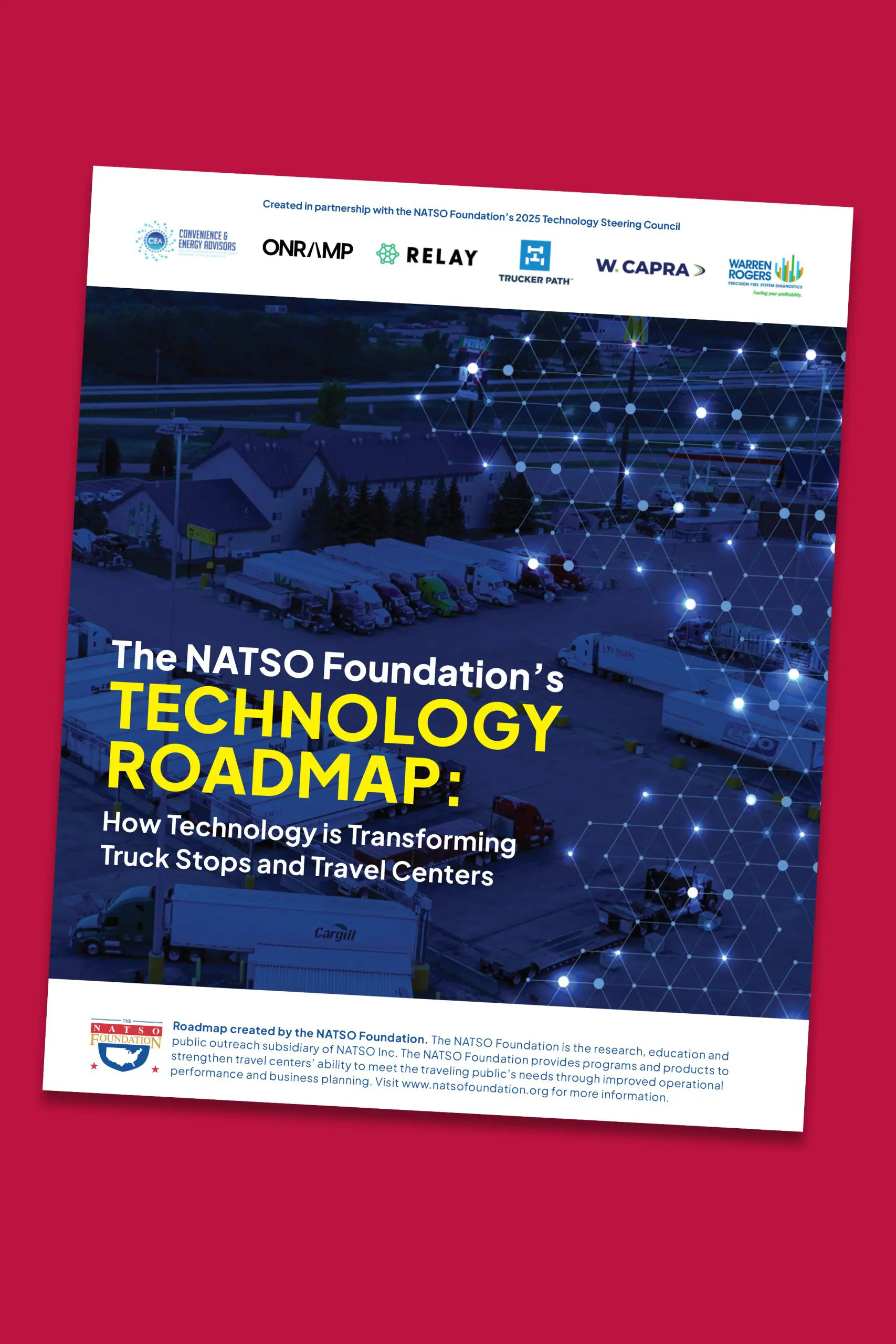
The NATSO Foundation and members of the NATSO Foundation 2025 Technology Steering Council recently created a Technology Roadmap to help travel center operators stay current on the technology landscape. Purchase a copy to gather their insights into how operators can use technology to their advantage and the most impactful tools travel centers should deploy today.


Subscribe to Updates
The NATSO Foundation and NATSO provide a breadth of information created to strengthen travel plazas’ ability to meet the needs of the traveling public in an age of disruption. This includes knowledge filled blog posts, articles and publications. If you would like to receive a digest of blog post and articles directly in your inbox, please provide your name, email and the frequency of the updates you want to receive the email digest.