Demand for Hydrogen Ramps Up as OEMs Make Progress on Heavy-Duty Hydrogen Vehicles

Article created for the digital issue of the NATSO Foundation’s magazine.
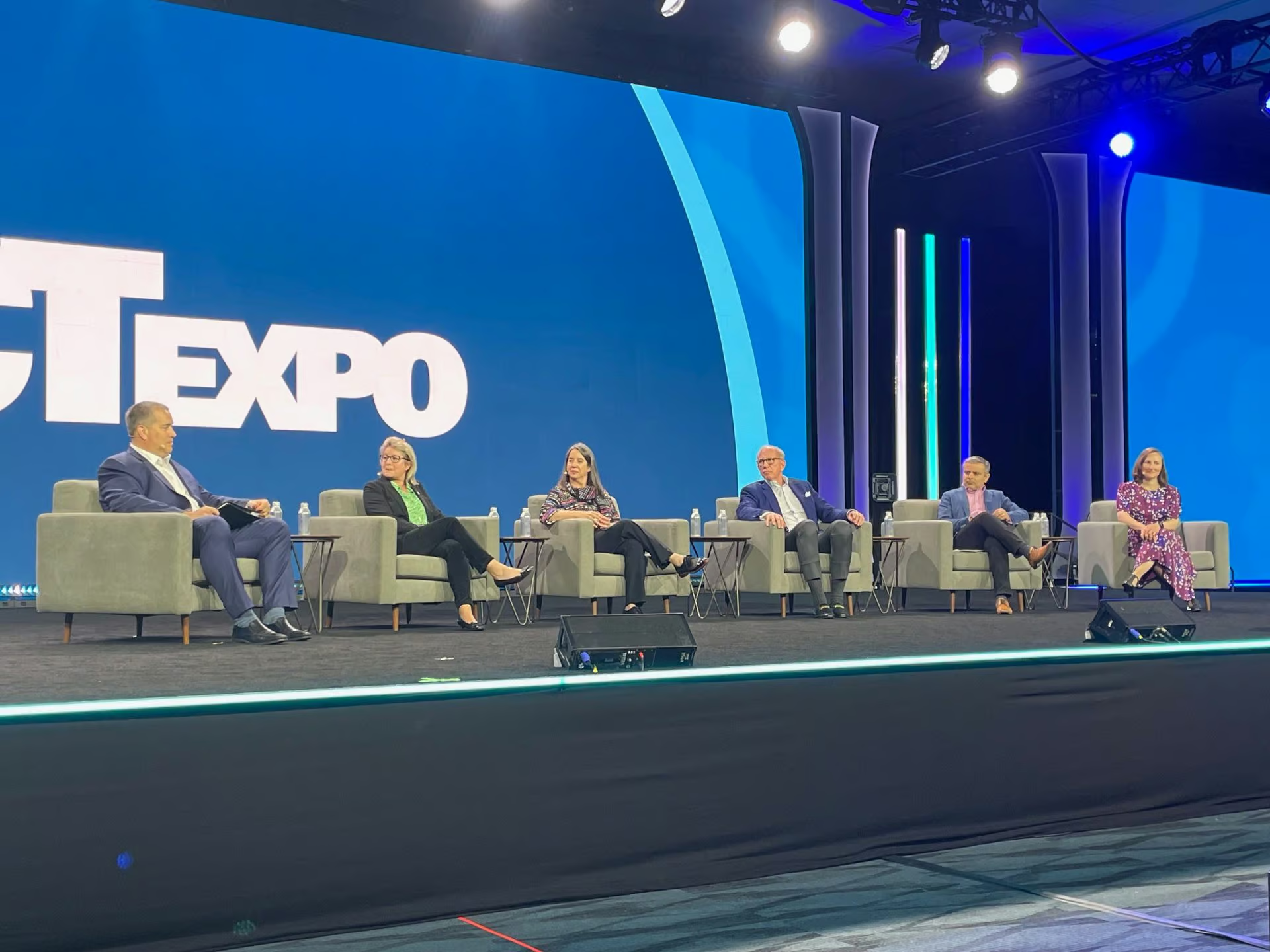
Original equipment manufacturers are proving out new hydrogen technologies to meet more stringent emissions requirements, and the new vehicle designs are expected to dramatically increase demand for hydrogen, according to speakers at ACT Expo 2024. (Read Pilot is Moving Forward with EV Charging and Hydrogen Fueling Infrastructure for more travel center news from the ACT Expo 2024.)
“Action is happening now in the four areas—policy, energy supply, infrastructure and vehicle supply,” said Eric Guter, vice president of hydrogen for Air Products and Chemicals Inc.

Hydrogen has a number of benefits for heavy-duty trucking.
Vehicles are fueled similar to how diesel is dispensed today, there is no extra weight, and vehicles can travel 500 miles or more before refueling. “Trying to mimic a diesel like fueling experience is the goal,” said Kimberly Okafor, general manager of zero emissions solutions for Trillium, a Love’s company.
Hydrogen can be used in hydrogen fuel cells or in internal combustion engines. Puneet Jhawar, general manager, global spark ignited and fuel delivery system business for Cummins, said the hydrogen internal combustion engine has been recognized by EPA as a zero-emission technology.
“It is capable of meeting the new, more stringent 2027 NOx regulations,” Jhawar said. “Within this one fuel type you could likely have a medium duty and heavy duty. It starts combatting a little bit with the diesel market.”
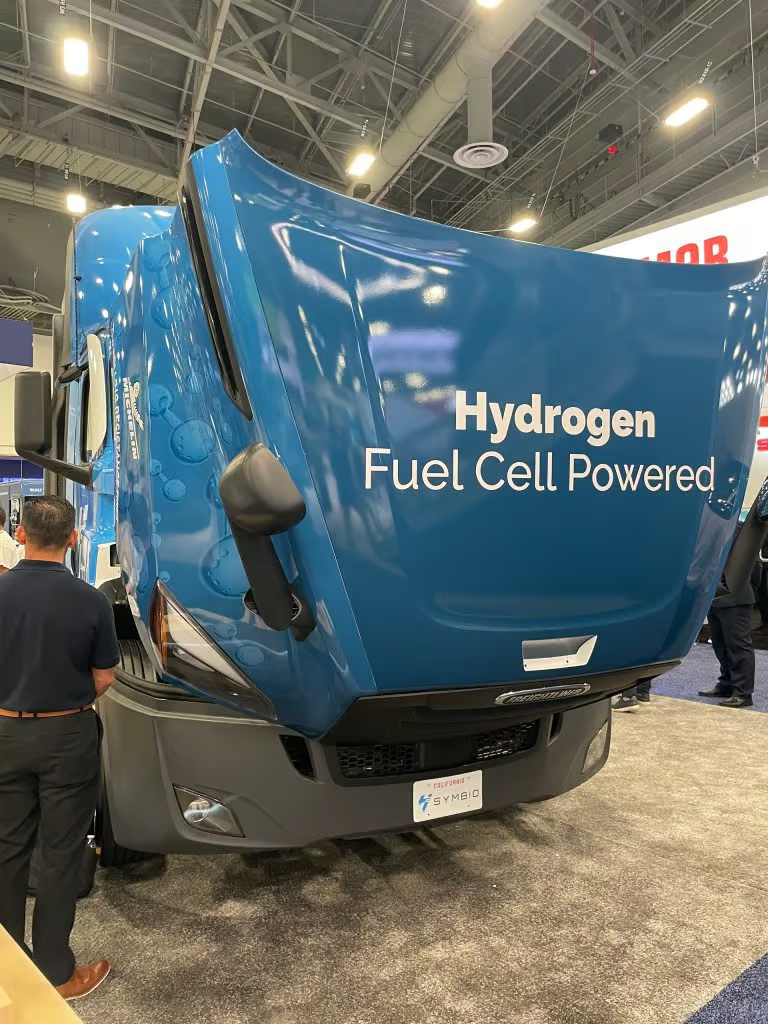
OEMs are deploying hydrogen trucks.
Martin Zeilinger, head of commercial vehicle development at Hyundai Motor Co., said Hyundai has fuel cell commercial vehicle deployments all over the world. “In Korea, running more than 500 fuel cell heavy-duty trucks,” he said.
Hyundai has also deployed hydrogen fuel cell trucks in California and has found that fuel cells are robust. “The customer proof is a great experience that gives us a big tailwind for the next steps, which we are planning to do and execute further,” he said.
OEMS are forming partnerships.
Several OEMs have formed partnerships to help bring hydrogen technology to market. “One thing I know our team has learned is that partnerships are the key to success here. I feel like we’re in a stage where we’re going from diesel to everything,” said Joe Adams, chief engineer for Kenworth Truck Co.
Cellcentric, a joint venture between Daimler Truck AG and Volvo Group, has created its core product, the BZA 150. “We can really develop fuel cell systems that are heavy-duty focused,” said Nicholas Loughlan, chief technology officer for cellcentric. “Our systems are designed to do exactly what you would expect from today’s diesel powertrain.”
Last year, cellcentric kicked off its NextGen project, which will have 30% more power density, 40% less complexity and 20% less fuel consumption compared to the BZA 150 and will be targeted to the North American market.
Paccar and Toyota partnered as part of the Zero- and Near-Zero Emissions Freight Facilities (ZANZEFF) “Shore to Store” project at the Port of Los Angeles, the Los Angeles basin and the Inland Empire. The OEMs jointly designed heavy-duty, Class 8 fuel cell electric vehicles program with Kenworth designing and building the Class 8 T680 FCEVs and Toyota designing and building the powertrain’s fuel cell electric power system powered by hydrogen placing 10 trucks into service.
“Kenworth’s T680 fuel cell is great opportunity to take one application in a world of zero-emission technologies and deploy it,” Adams said, adding that the OEM is in the process of dialing it in and will run pilots in late 2024 and early 2025. “We are really confirming we have the right recipe of integrations on the fuel cell.”
Adams added that the companies expect to have production units in late 2025. Kenworth is working with customers and getting deposits on the trucks they want to buy. As part of the process, the OEM is asking them if they have hydrogen and what lanes they are going to run. “This will help with the chicken and the egg scenario,” Adams said. “This has been really important for us as we go to market.”

What about hydrogen fueling infrastructure?
Getting hydrogen vehicles on the road has proven the capabilities of the technology, but the infrastructure side is creating a bottleneck. “The hydrogen price and the supply of the fuel itself is something that is still being attacked by cross collaboration,” Loughlan said. “It needs partnerships across industry sectors and with public, legislative policy makers in order to set the right framework. That is something similar in Europe and North America.”
Okafor said Love’s is making hydrogen available and has five hydrogen stations. “Infrastructure is the piece we’re focused on,” she explained while moderating a panel discussion on hydrogen.
Air Products and Chemicals has made an investment of $15 billion to execute large, clean hydrogen projects. “We are building commercial multi-modal stations. Our new high-capacity stations allow for equipment redundancy and storage,” Guter explained.
Guter also emphasized the need for collaboration. “Over the next 25 years, we must remake the world’s energy infrastructure system, which is something that took us more than 100 years,” he said.
// This article was created for Stop Watch magazine, the magazine of the NATSO Foundation. Foundation is the research, education and public outreach subsidiary of NATSO, Inc. The NATSO Foundation provides programs and products to strengthen travel plazas’ ability to meet the traveling public’s needs through improved operational performance and business planning. Visit www.natsofoundation.org for more information.
Additional hydrogen resources from the NATSO Foundation include:


Subscribe to Updates
The NATSO Foundation and NATSO provide a breadth of information created to strengthen travel plazas’ ability to meet the needs of the traveling public in an age of disruption. This includes knowledge filled blog posts, articles and publications. If you would like to receive a digest of blog post and articles directly in your inbox, please provide your name, email and the frequency of the updates you want to receive the email digest.