Analysis Confirms Commercial Rest Areas Limit Truck Parking Capacity
Alexandria, Va. — A new report issued today by NATSO, the national association representing the truckstop and travel plaza industry, finds 69 percent more commercial truck parking spaces per mile along interstate highways where the private sector caters to the needs of the traveling public free from government competition at commercial rest areas.
The report titled, Rest Area Commercialization and Truck Parking Capacity 2018, updates a 2010 analysis of the relationship between commercial rest areas, which are operated by the government and located directly on the Interstate right-of-way, and total truck parking capacity.
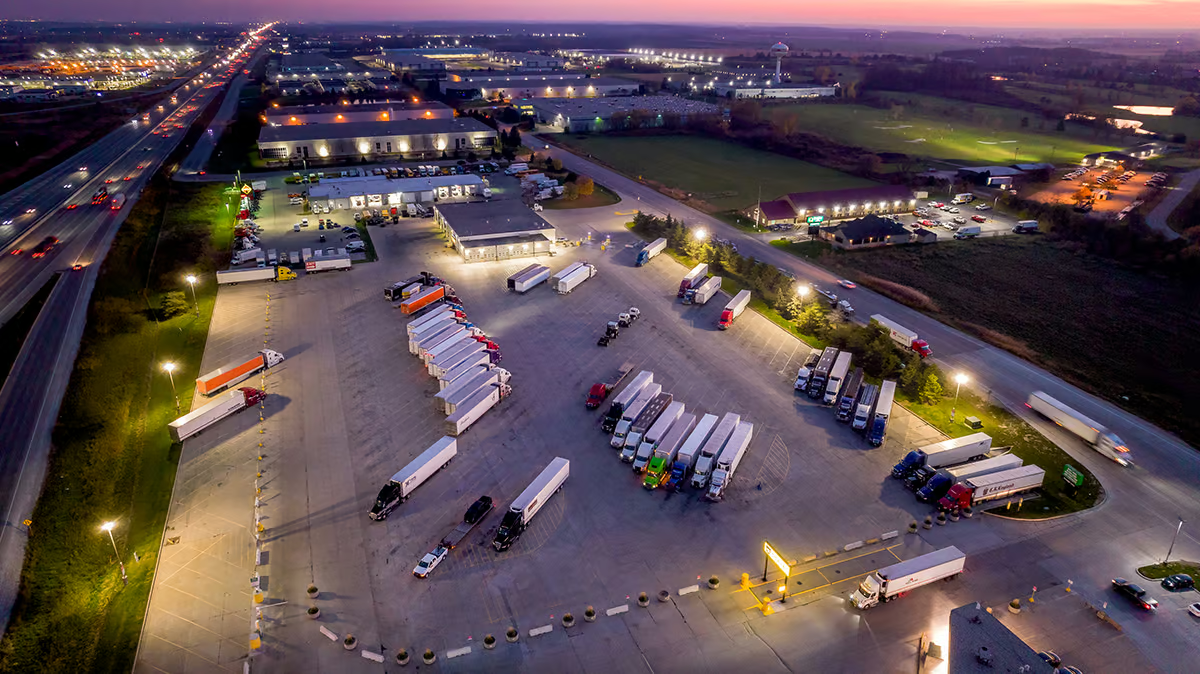
“This study highlights that commercial rest areas result in significantly fewer truck parking spaces and do not represent a viable means of expanding commercial truck parking capacity,” said NATSO President and CEO Lisa Mullings. “This reaffirms the industry’s position that truck parking is best handled by the private sector, which provides nearly 90 percent of the nation’s truck parking.”
Conducted by Dr. Ronald Knipling of Safety for the Long Haul Inc., the research examined the correlation between interstate corridors’ total truck parking capacity and the presence of commercial rest areas on the right-of-way.
Since 1960, Federal law has prohibited the sale of food, fuel and other commercial service from rest areas located directly on the Interstate Highway System to prevent the granting of monopolies along the Interstate right-of-way. Congress permitted the continued operation of commercial rest areas in states where commercial rest areas existed prior to the enactment of the law. This study evaluated those states where grandfathered commercial rest areas continue to operate.
Using independent third-party data from 13 states to compare the number of truck parking spaces on commercialized and non-commercialized segments of the Interstate Highway System, Dr. Knipling confirmed a negative relation between the presence of commercial rest areas and total truck parking, and also found a greater negative relation than in 2010.
The research, which evaluated more than 12,000 interstate miles, found that non-commercialized interstate corridors have 6.57 truck parking spaces per mile, or 69 percent more than the 3.88 spaces per miles on the commercialized interstate segments. Non-commercialized interstate segments have, on average, one truck parking facility every 8.4 miles, compared with commercialized interstate segments with one facility every 12.8 miles. All public and private designated truck parking located within one mile of the interstates was included in the totals.
“Rest area commercialization is sometimes proposed as a means of increasing truck parking capacity along the Interstate Highway System,” said Dr. Knipling. “This study underscores that the private sector is far better at meeting the parking needs for the nation’s truck drivers.”
To download the full report click here.

Subscribe to Updates
The NATSO Foundation and NATSO provide a breadth of information created to strengthen travel plazas’ ability to meet the needs of the traveling public in an age of disruption. This includes knowledge filled blog posts, articles and publications. If you would like to receive a digest of blog post and articles directly in your inbox, please provide your name, email and the frequency of the updates you want to receive the email digest.