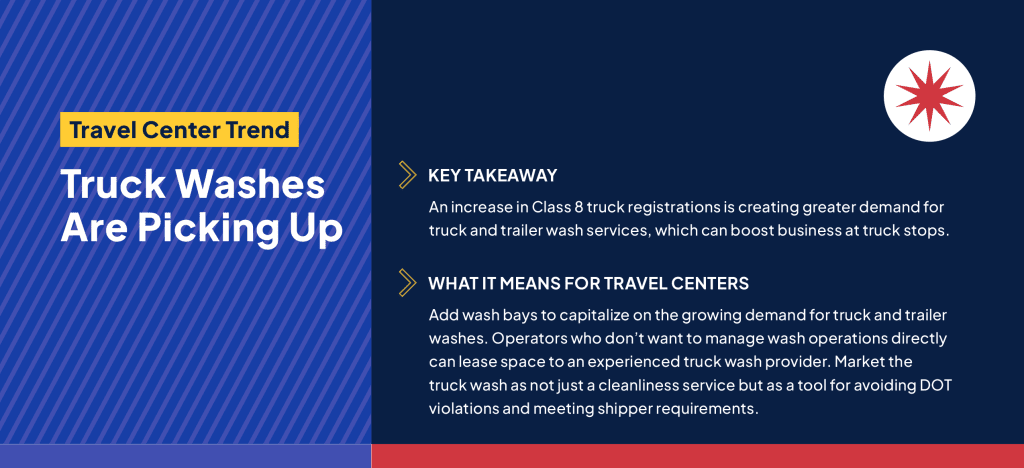
Class 8 truck registrations are trending upward, creating more opportunities for truck and trailer washes. Clean trucks not only help fleets improve their image but also help minimize the risk of corrosion from road salts and grime buildup. There are also regulatory requirements mandating trailer washes depending on the type of trailer and the commodity being hauled.
Fleets and drivers often plan stops based on the services available, which could help locations with truck washes boost business.
Hendon said her proximity to California also contributes to demand. “California has very high regulations,” she explained. “Trucks that move freight into California have to be clean or they will be pulled over for a DOT check. My motto has always been Wash today and keep DOT away.”
Nick Wollenman, general manager of Deluxe Truck Stop, said a lot of the location’s existing customer base for exterior washes are local fleets and farmers, but starting in late 2024 and into this year, he has seen more non-local drivers come in for exterior washing. “To be honest most of them are filthy dirty and really need the wash,” he said.
Deluxe Truck Stop also offers trailer washes and saw a boost when a local plant discontinued its interior trailer washout late in 2024. “It has driven a sizable amount of them here, which ties into some of them wanting to do the exterior washing as well,” Wollenman said.

Understanding Washout Requirements
Legal requirements for washing out dry van trailers, refrigerated trailers (reefers), and tanker trailers vary based on factors like cargo type, federal and state regulations, and shipper requirements. “If the company gets caught not washing out their trailers it is a very high fine,” Hendon said.
Washouts are especially important for trailers hauling food-grade products. The federal Food Safety Modernization Act established cleanliness standards and mandates proper sanitation for food transport, requiring carriers to ensure trailers are clean and prevent contamination. Some states have agricultural biosecurity regulations, requiring washouts before loading fresh produce, dairy, or meat.
Tanker trailers have some of the strictest regulations, especially for food-grade products, chemicals and hazardous materials. Wollenman said the location’s expertise in interior trailer washouts helps attract customers.
“We know the importance of the hopper/refer/dry van washouts due to the nature of what products are being hauled from our local production facilities,” he said, adding that most of the local production facilities require drivers to present a wash ticket come through check in. “This becomes a necessity to load.”
Deluxe Truck Wash also offers kosher washes. “This is a process that is regulated by the Juice Products Association (JPA),” Wollenman explained. “This is a very process and specific wash to make sure the industry standard is followed.”
Evaluating Truck Wash Options
There are several factors that operators need to evaluate when considering truck washes, such as if they’re going to wash the exterior only or if they’re going to offer additional wash services, such as tanker/trailer washouts, brighteners, sanitizers, kosher washes, etc.
An important consideration in evaluating truck wash services is the local sewage treatment plant capacity. Some municipalities have very restrictive effluent discharge load limits (BODs, CODs, fat grease and oil, suspended solids, PH, etc.). Many don’t have the treatment capacity to handle the additional loads that truck washes, especially those offering tanker trailer washouts, emit. Larger municipalities typically can handle waste on an industrial scale necessary, while smaller communities usually do not.
For example, Hendon said Danny’s Truck Wash cannot wash out fertilizer or chicken fat in the trailer washout.
The amount of space available is another key consideration. Locations need at least 90 feet if the truck is in an optimal position and may want to go longer, such as 100 feet, if possible. Depending on the type of washes offered, employees need room to maneuver around the truck with the truck hood open. For tanker wash outs, the wash bay needs to be tall enough for employees to access the top of the trailer and necessary equipment such as catwalks.
If operators don’t want to operate the wash themselves, they can lease space at the location, allowing a partner to run the truck wash business on their property.
As a best practice, drivers generally should pull the truck into and out of the bay. Some truck stop locations do have employees pull them in and out, but that creates risk associated with damage, dogs and sleeping codrivers in the truck, etc. There is also a risk of potential accusations of theft if something is missing.
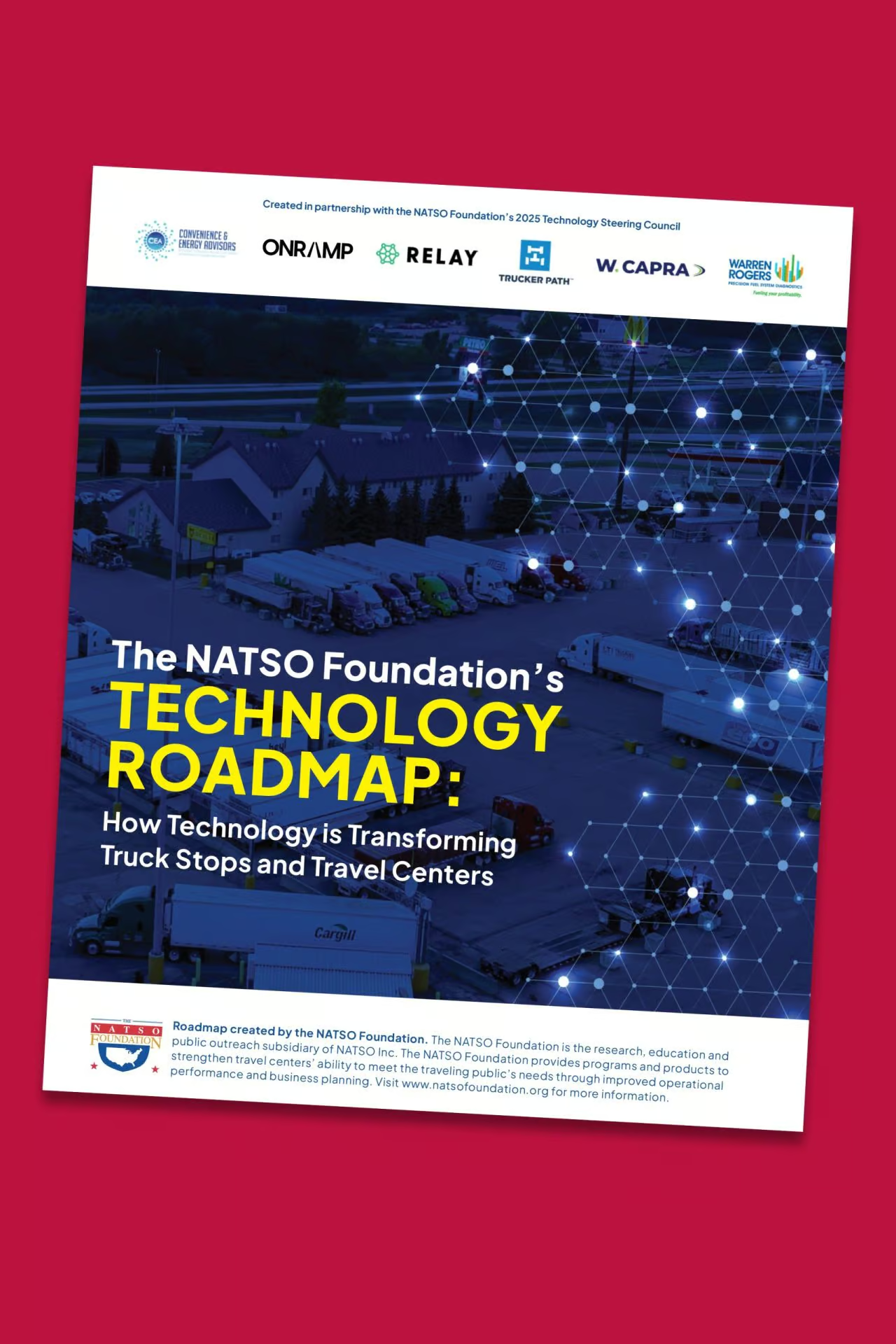
Top Microtrends Shaping the Truck Stop and Travel Center Industry in 2025 Report
Staying ahead of industry trends—especially microtrends—enables travel centers to seize new opportunities, adapt to market dynamics and meet customer needs proactively. The NATSO Foundation created the Top Microtrends Shaping the Truck Stop and Travel Center Industry in 2025 Report to provide actionable insights to help operators maintain a competitive edge.
The Top Microtrends Shaping the Truck Stop and Travel Center Industry in 2025 Report was created with generous support from CAT Scale.


Subscribe to Updates
The NATSO Foundation and NATSO provide a breadth of information created to strengthen travel plazas’ ability to meet the needs of the traveling public in an age of disruption. This includes knowledge filled blog posts, articles and publications. If you would like to receive a digest of blog post and articles directly in your inbox, please provide your name, email and the frequency of the updates you want to receive the email digest.