Translating Trucking Trends Into Profitable Action Items At Your Truckstop
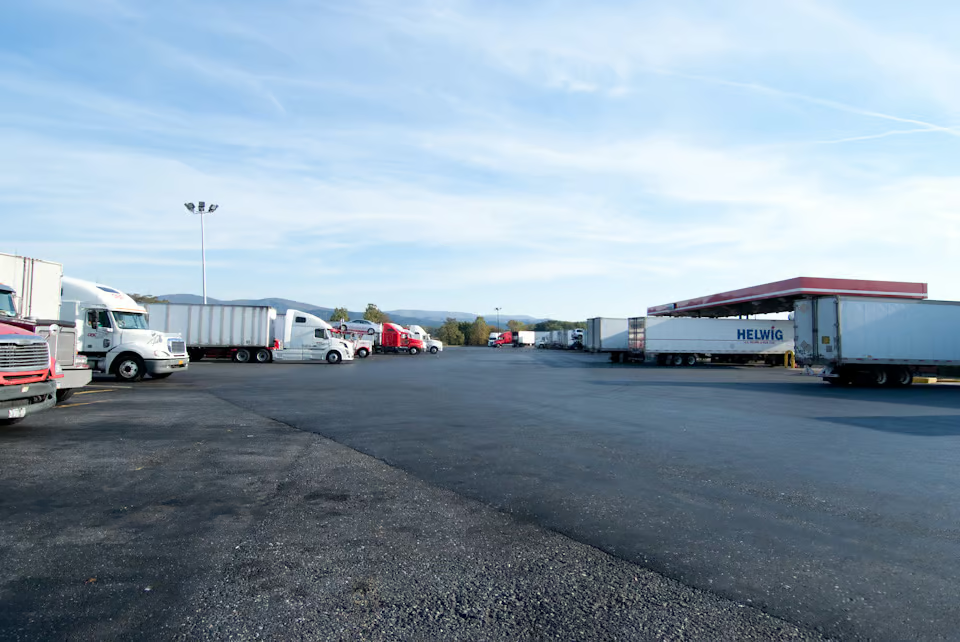
The successes and challenges the trucking industry experiences have a significant effect on the nation’s truckstops and travel plazas, which means staying current on trucking trends is crucial for businesses that serve drivers. What’s more, successful truckstop and travel plaza operators know that trends often result in new opportunities.
Stop Watch sat down with experienced industry leaders to gain their insights into the latest trucking trends and what they mean for highway-based businesses.
Increased Fuel Efficiency
As fuel efficiency increases and carriers embrace alternative fuels, truckstop operators will experience reduced demand for diesel fuel, said Roger Cole, editor of the NATSO Foundation’s Biz Brief. The same trend translates into passenger vehicles as well.
“Toyota announced that it wouldn’t be making gasoline passenger cars in 2040. That is 25 years out, but that is a dot they’ve put out there on the calendar,” Cole said, adding that Toyota has said it will pursue electric energy.
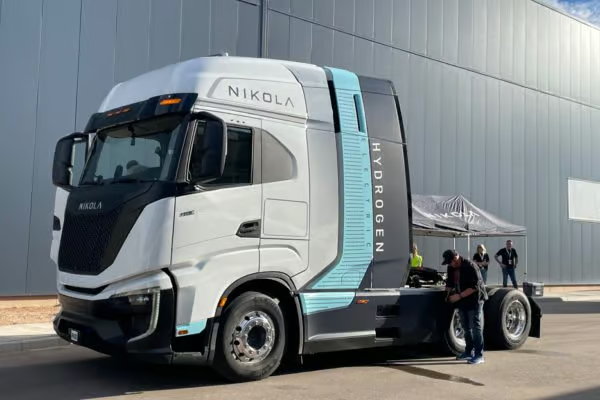
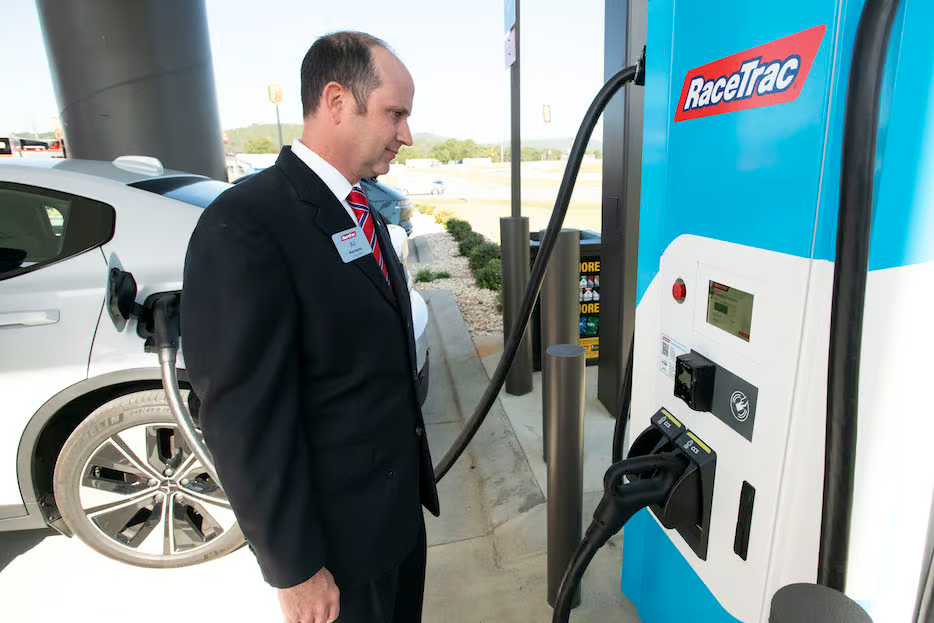
Embracing alternative power sources may be a solution for truckstop and travel plaza operators looking to diversify their offerings. “While I think it is still too early for many to jump into the natural gas arena, at the very least an independent operator ought to be educating him or herself on electric charging stations, compressed natural gas and liquified natural gas and the dynamics and watching to see when it is time to make an investment,” Cole said, adding that by educating themselves, operators can determine the benchmarks that have to be reached before they make an investment.
Decreasing fuel sales also mean that operators may seek out ways to spur sales in other areas of the business.
Jim Goetz, owner-operator of Petro Travel Plaza in Portage, Wisconsin, and vice president of Goetz Co., said that although professional drivers remain a core customer base, the location is working to increase other customers, which is working. “Gas prices are down and the number of people working is up, so our biggest growth has been through the non-truck driver,” Goetz said, adding that the location has seen an increase in micro-beer and liquor sales. “We have added liquor sales for both local traffic and tourists.”
Sales of popular Wisconsin beers have taken off, particularly of Spotted Cow, a beer that is only sold in Wisconsin, which now accounts for 25 percent of all of Goetz’s beer sales.
The Driver Shortage
Carriers continue to be concerned over the shortage of professional truck drivers, which the American Trucking Associations’ 2015 Driver Shortage Analysis estimates was roughly 48,000 at the end of 2015, and could grow to 175,000 by 2024. Over the next decade, the trucking industry will need to hire a total of 890,000 new drivers, or an average of 89,000 per year, the analysis said.
To help attract and retain drivers, many carriers are paying higher wages, which could give drivers more disposable income to spend. “Most fleets instituted large pay increases in the summer of 2014 with many repeating the increases again in 2015. Sign-on bonuses are used throughout the industry as well,” the analysis said. “Expect driver pay to continue rising as long as the driver shortage continues.”
Carriers are also placing an emphasis on equipment, which could create opportunities within the maintenance shop.
Dan Alsaker, president of Broadway Truck Stops, said the industry might begin to see an Uber-like business model for commercial drivers where carriers could rent drivers. “We’re going to find a driver with no truck or trailer. Carriers will be able to find these folks and use them as they need them and when they need them,” he said. “The truckstops will be magnets for a kiosk or a venue where carriers can rent drivers. I think that will explode and some of us will be on the forefront of that and be able to capitalize on an Uber-like service.”
Changing Demographics Of Drivers
The makeup of the professional driver base is shifting, which could result in new sales opportunities for locations.
ATA’s 2015 Driver Shortage Analysis reported that today 38.6 percent of drivers are minorities, which has jumped 12 percentage points from 26.6 percent in 2001.
Carriers are also working to attract more women to the industry, which ATA said is a large, untapped portion of the population. “Females make up 47 percent of all U.S. workers, yet only comprise 6 percent of all truck drivers, according to the U.S. Department of Labor. The share of female drivers has remained stagnant between 4.5 percent and 6 percent since 2000,” ATA said in its analysis.
Alsaker said more Millennials will be entering the workforce as drivers. “In my mind, Millennials are people who want to make quick decisions,” he said.
That mindset could spur impulse purchases. “One of the things we think is trending are what we used to call trinkets—the inexpensive things—we’ll continue to do that, but what we’ve discovered is that a mini-version of food offerings—a deli case, a hot case, a cold case—at our fuel desk will appeal to the Millennial generation,” Alsaker said.
Alsaker said he has been watching the trend towards food trucks and thinking through how he could use them at his locations. “They’re being embraced as a fundamental way that Millennials are eating,” he said. “We see that as a big trend that we’re going to try to push our resources into rather than put in a fixed base.”
Alsaker said he envisions having clusters of food trucks, such as three to four vans that are in place during meal times. “I am convinced it is going to be part of the landscape sooner rather than later, particularly with $15 minimum wage. None of us will be able to afford the traditional family-style restaurant,” he said.
“We can thank the Millennials for reminding us convenience is important. Those of us that are able to adapt will see our results be commensurate with the outcomes,” Alsaker said.
Shorter Length Of Haul
In order to cut down on delivery times, retailers are trying to get closer to their customers and have been opening smaller, regional distribution centers. More often than not, they are positioning those distribution centers next to rail lines. “They go out of the distribution center by truck, but you’ve cut a lot of miles out that would have been traditionally carried by truck. That is part of the demand reduction,” Cole said.
Shorter lengths of haul could also help attract and retain drivers. “The increased prevalence of retail distribution centers and use of the hub-and-spoke system have drastically reduced the average length of haul across the industry; this reduction in travel distances could and should translate to less time on the road for drivers,” ATA said in its driver shortage analysis. “However, the industry can only reduce length-of-haul and increase at-home time so much.”
As lengths of haul decrease, operators could see an increase in certain inside sales, such as food, Cole said.
Tom Heinz, president of Coffee Cup Fuel Stops, said he has observed that regional trucking companies are becoming more concentrated with multiple trailer types in their fleets, which allows them to grow their business and haul more products while staying within the region. “This can be a curse or a blessing to operators in their market dependent on the proximity from their terminal and the size of the carrier,” he said.
Shifting Freight Patterns
Freight patterns are shifting, which is driven, in part, by the movement of ocean freight from the West Coast to the East Coast. “What do you do about that? I’m not sure there are any easy answers, but it is all part of the trend. You may want to start seeking out alternative sources of revenue,” Cole said, saying additional food offerings may be an option. “It will likely take looking outside of the box for something we aren’t even thinking about today.”
Heinz said he has seen that his car hauler customers seem to be bringing in more foreign cars into the upper Midwest from the port in Jacksonville, Florida. “I assume they’re doing the same in other parts of the country,” Heinz said, adding that he believes it could be due to the widening of the Panama Canal as well as a growing number of foreign cars entering the market. “For the trucking industry and operators, it should be advantageous,” Heinz said.
Cole predicts that shifts in production capabilities and new technology, such as 3-D printing, will also alter fuel use. “Today it is happening on a small-scale level, but I guarantee that in 25 years it will have a bigger impact on supply chain,” Cole said.
A Greater Focus On Driver Health
There have been a number of initiatives, whether through individual companies or the government, to improve driver health. Cole said overall he is seeing a decrease in the sale of tobacco products, particularly as states increase tobacco taxes. “Indiana is looking to raise the tax on cigarettes $1 a pack. At some point, even though it is an addiction or a habit, when it gets to be $9 a pack, people will quit smoking,” Cole said. “I think you replace those with more healthy options, but I’m not sure what they are. Operators may consider adding more sugar-free candy and placing it closer to tobacco so your customer has an option.”
Increased Fuel Taxes
With both state and local governments looking for new sources of revenue, fuel taxes are likely to increase. “There are a lot of counties that have the option to impose fuel taxes. Those that can are doing so,” Cole said. “If you happen to have a truckstop in a county that increases fuel taxes, you are non-competitive to the truckstop that is 25 miles down the road in a different county.”
To help work with lawmakers, Cole said independent operators could become more active in the political process throughout the year and not just when issues arise. “The guy that comes along every five years and says, ‘You have to listen to me,’ doesn’t hold nearly as much water as the guy the legislator sees a couple of times a year,” Cole said.
Changing Regulations
Drivers have experienced a number of regulatory changes in the past few years and more are to come. Electronic logging devices will become mandatory in 2017, which will likely alter their stopping habits.
“Electronic logging makes it very difficult for drivers to now say, ‘I know I’m out of hours but there is a truckstop I want to go to 40 minutes up the road.’ We may see a lot of our customers who were routine customers have to re-plan their days and stops,” Alsaker said. “The question becomes what are the alternatives we can provide to help them plan their trips and schedules?”
Heinz said electronic logging devices might be a blessing for operators. “We do well when our customers do well. By the information out there, it looks like electronic logging devices should be good for our customers,” Heinz said, adding that the devices are reported to reduce
crashes by 12 percent and result in a drop in speeding and harsh braking incidents, 25 percent savings in fuel costs and 30 percent savings in unproductive idling. “Assuming these are true, electronic logging devices should wring some of the transportation cost out of most things Americans buy.”
“In talking with customers, its likely more trucks will be needed to haul like amounts of freight,” Heinz said. “If so, that will not correlate into more gallons of diesel sold but should drive more food sales.”
Changing regulations could also mean drivers are parking longer, which would give operators more opportunities to boost sales. “If you have high-speed Wi-Fi at your sites, you can possibly charge for it,” Heinz said.
While operators are waiting to see exactly how e-logs will affect the industry, operators said hours-of-service regulations have also made drivers’ time more valuable. Heinz has embraced several tools that can help him serve customers faster. “We’re trying to make our locations more user friendly and trying to provide the latest technology at the dispensers and the fuel desk so they don’t have to wait in line if they don’t want to,” Heinz said. “In our food courts, we’re trying to make sure we’re staffed properly at the right times.”
Alsaker said he has seen a move toward expanded convenience for drivers as some locations that once offered fuel with limited services are actually adding services. “We’ve seen a shift from super convenience to really expanded convenience to where it is almost a full-service location with tire shops.”
Heinz said ELDs as well as hours-of-service regulations might also result in increased hotel stays for drivers. “Comdata’s recent announcement of its Comdata Hotel Network Payment System with hotel discounts to drivers using their card for payment suggests HOS will increase the use of hotel rooms,” Heinz said.
Increased Demand For DEF
Newer equipment requires diesel exhaust fluid, and sales of DEF will increase as fleets turn over their equipment. Goetz said his location has seen growth in DEF bulk sales. “As new equipment was purchased, the amount of bulk DEF gallons went up. The ROI there has been positive,” he said.
Photo Credit: Ira Wexler/NATSO

Subscribe to Updates
The NATSO Foundation and NATSO provide a breadth of information created to strengthen travel plazas’ ability to meet the needs of the traveling public in an age of disruption. This includes knowledge filled blog posts, articles and publications. If you would like to receive a digest of blog post and articles directly in your inbox, please provide your name, email and the frequency of the updates you want to receive the email digest.