Fuel Retailers Oppose Legislation Threatening Private Investment in EV Charging
ALEXANDRIA, VA — NATSO, representing truck stops, travel centers and off-highway fuel retailers, SIGMA: America’s Leading Fuel Marketers, and the National Association of Convenience Stores (NACS) voiced strong opposition to the RECHARGE Act, introduced by Senator Jeff Merkley (D-Ore.), which threatens private investment in electric vehicle charging stations by amending the longstanding federal law prohibiting automotive services at rest areas.
“The RECHARGE Act will not boost the number of EV charging stations available to drivers but rather will inject a nationwide hurdle that discourages the development of a safe and reliable EV charging network,” said David Fialkov, Executive Vice President of Government Affairs for NATSO and SIGMA. “Rather than upending policies designed to further the deployment of EV charging stations, we encourage lawmakers to reject any proposals that inhibit private sector EV charging initiatives and instead enact policies that catalyze fuel retailers who remain committed to building out a safe, reliable network of EV charging stations.”
“EV drivers should have competitive places to recharge just like we have competitive places to refuel,” said Matt Durand, Deputy General Counsel for NACS. “If we commercialize rest areas, it will undermine the dynamics that have helped build a refueling network and permanently put EV charging at a disadvantage – exactly the opposite of what the proponents of this bill want.”
For nearly 70 years, federal law has prohibited the sale of automotive services and food at state operated rest areas to encourage competition between private businesses located at the Interstate exit exchanges. That ban has been a central element to the healthy economic development of restaurants, convenience stores, truck stops, hotels, and an array of other commercial offerings at highway exits. Allowing EV charging stations at rest areas will discourage private investment in electric fuel by creating an unlevel playing field in which state governments do not have to compete for customers.
The RECHARGE Act comes at a time when U.S. DOT has unveiled Interim Final Guidance aimed at ensuring a consumer-oriented approach to state EV charging station implementation. This guidance includes a provision that encourages the selection of charging locations where the charging station owner is also the site host to ensure that investments made with public funds are directed to the ideal site locations. Fuel retailers applaud the Administration for adopting a flexible approach that will help to direct public funds to charging sites that are best positioned to deliver reliable, well-maintained charging infrastructure.
NATSO Comments on Interim Final NEVI Guidance
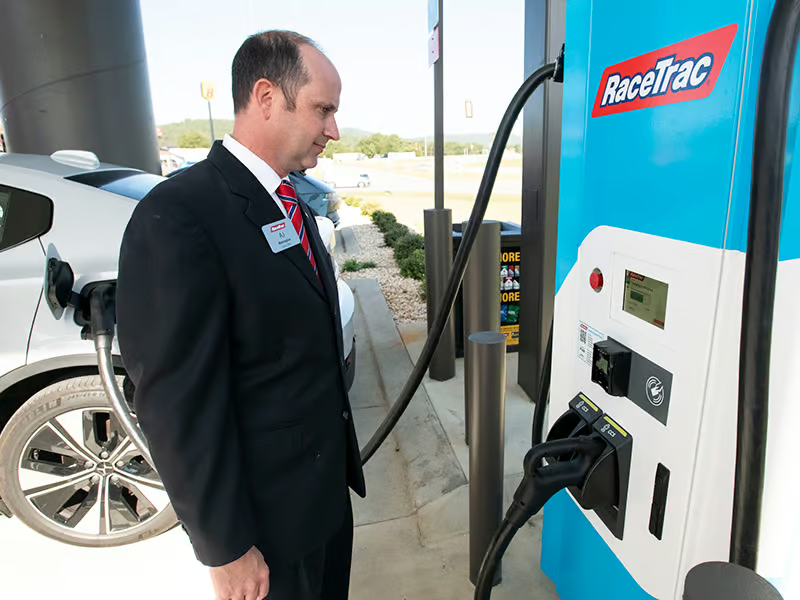
Truck stops, travel centers, convenience stores, and fuel marketers are leaders in today’s rapidly evolving refueling landscape. Fuel retailers are making significant investments in electric vehicle charging stations, and many are working with their state departments of transportation to install EV charging stations at locations off the Interstate Highway System.
Congress directed state transportation departments to work with the private sector to kick-start a nationwide network of electric vehicle charging stations. The Infrastructure Investment and Jobs Act included provisions ensuring that locations for alternative fueling must consider the availability of amenities such as food and restrooms. It refrained from incorporating provisions that would allow states to unfairly compete with the private sector by installing EV charging stations at rest areas.
A coalition of private businesses, including truck stops, fuel retailers, convenience stores, restaurants, blind entrepreneurs and local governments sent a letter urging Senate lawmakers to reject the RECHARGE Act.
Thousands of truck stops, travel centers, fuel retailers and convenience stores are conveniently located less than one mile from highway exits, are highly visible and provide the amenities such as security, food, and restrooms that customers need while taking 20 to 30-minute breaks during long-distance travel. Widespread availability of DC fast chargers at these facilities will make consumers more comfortable purchasing EVs.
###

Subscribe to Updates
The NATSO Foundation and NATSO provide a breadth of information created to strengthen travel plazas’ ability to meet the needs of the traveling public in an age of disruption. This includes knowledge filled blog posts, articles and publications. If you would like to receive a digest of blog post and articles directly in your inbox, please provide your name, email and the frequency of the updates you want to receive the email digest.