Drivers Drivers to Remain Critical Even as Autonomous Technology Grows
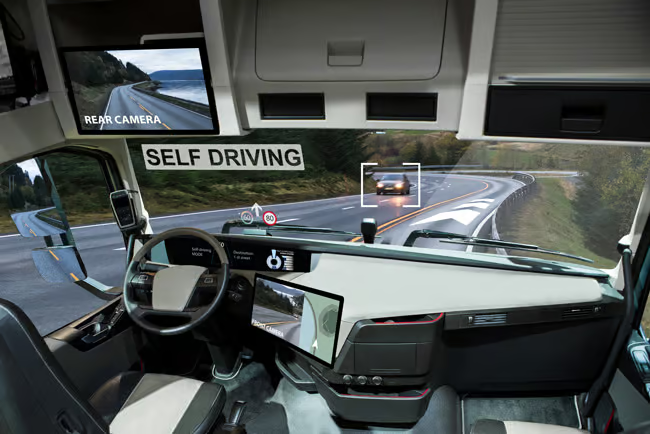
Autonomous technologies are continuing to make headlines. A handful of new startups, such as Waymo, as well as most major Class 8 manufacturers, including Paacar, Daimler and Volvo, are already testing autonomous technology. While the technology could be used to improve safety and, potentially, create self-driving vehicles, many within the trucking industry believe drivers will remain necessary.
Bob Costello, chief economist for the American Trucking Associations, compared autonomous technology within the trucking industry to that used in the airline industry. Although auto-pilot technology could fly the plane, pilots must oversee the operations and take over the controls when necessary. “If something goes wrong outside of a catastrophic event, you have a while to deal with that event,” he said while speaking during NATSO Connect 2018. “I can’t imagine at this point the federal government will say to go ahead and take the driver out of the driver’s seat.”
Recognizing the Work Drivers Do
Drivers not only navigate the vehicle on the road, but also perform several critical functions, including conducting pre-trip inspections, fueling the truck and completing paperwork with customers at pick up and deliveries. There are several key areas where drivers likely will remain a key link in the supply chain.
Operational Intervention: As everyone knows, even the best technology can fail, and a human can intervene when needed. This is especially important in an environment when seconds count.
Equipment Inspection: Drivers are trained to check equipment and can visually identify potential problems. What’s more, they’re legally required to do so. Under current federal requirements, all tractors and trailers must be inspected for safety and drivers inspect equipment both pre- and post-trip. They can also investigate any equipment concerns that arise while a truck is out on a route.
The Final Mile: Even if autonomous technology develops to the point that driverless trucks can maneuver the highway, drivers will likely need to navigate the final mile of deliveries, which tend to be more complex. Today’s autonomous trucks do not have the capability to make deliveries in places that require strategic maneuvering or that aren’t GPS friendly.
Home Deliveries: More and more of today’s consumers are buying products with the click of a mouse, which means more deliveries are arriving in cardboard boxes at the shoppers’ doors. What’s more, as online shopping increases, shippers are increasingly interested in onsite installation of purchases, such as appliances. To differentiate themselves and capture business, a growing number of trucking companies are adding white-glove delivery services. The increased driver involvement those deliveries require couldn’t be replaced by autonomous technology.
In-store Deliveries: Consumers love fresh food, and in today’s retail environment, shoppers won’t settle for products that aren’t at their best. For some retailers, an increased emphasis on fresh foods has led them to replace traditional truckload deliveries through the back of the store with more frequent deliveries brought into the store by drivers. At some locations, drivers even stock shelves and replenish coolers.
Meeting Drivers Needs
Darren Schulte, vice president of membership for NATSO, said there is a big difference between driverless vehicles and autonomous technology that is designed to improve safety, such as adaptive cruise control or collision avoidance systems.
Even if technology did allow drivers to take their hands off of the wheel, it could create new opportunities for truckstops and travel plazas.
“I’m going to take a positive approach. I think there are opportunities for truckstop and travel plaza operators to have repair stations because cameras or other technologies are going to break and early warning detection systems will malfunction,” Schulte said.
Autonomous vehicles could also create additional sales opportunities for operators. “It has the potential to change the products and offerings we carry,” Schulte said. “Can a driver travel and play Fortnite? Are there foods today we don’t sell as grab and go because it isn’t as convenient to eat that all of a sudden become an option? Could a driver eventually have a Keurig machine in the cab and we sell K-cups? I think that is going to be stuff that we think about.”
Photo credit: Bigstock

Subscribe to Updates
The NATSO Foundation and NATSO provide a breadth of information created to strengthen travel plazas’ ability to meet the needs of the traveling public in an age of disruption. This includes knowledge filled blog posts, articles and publications. If you would like to receive a digest of blog post and articles directly in your inbox, please provide your name, email and the frequency of the updates you want to receive the email digest.