Community, Business Leaders Urge Congress to Support Private Investment in EV Charging Infrastructure as House Committee Prepares to Unveil Transportation Bill
The best way to increase proliferation of electric vehicle (EV) charging infrastructure throughout the United States is through private sector investment by businesses that currently serve the motoring public, a coalition representing cities and communities across America and tens of thousands of off-highway businesses, including truck stops and travel centers, convenience stores, restaurants, hotels and blind entrepreneurs, said June 2 in a letter to Congress. The groups specifically noted that permitting EV charging stations at Interstate rest areas would discourage such investment and thus be counterproductive.
NATSO, along with the National League of Cities, National Association of Convenience Stores, Society of Independent Gasoline Marketers of America, the National Restaurant Association, National Federation of the Blind, National Retail Federation and Asian American Hotel Owners Association, asked lawmakers to promote investment in America’s infrastructure and design policies that attract private sector investment in electric vehicle charging infrastructure.
[Read the June 2 Coalition Letter Here]
The letter was sent as the House Transportation and Infrastructure Committee prepares to unveil its long-awaited version of a surface transportation bill. The House Committee is expected to official release its bill on June 4, with a mark up scheduled for June 17.
Although official language has not yet been released, early reports indicate that it will call for $350 million per year for grants for electric vehicle charging and hydrogen fueling infrastructure. The measure would focus funding on designated Alternative Fuel Corridors and projects that demonstrate the most effective emissions reductions.
Three House Committee Chairmen unveiled a framework in January that called for reducing the carbon footprint from the transportation sector and dramatically increasing the availability of electric vehicle charging stations and other alternative fueling options for electric and zero-emissions vehicles.
[House Committee Chairs Unveil Infrastructure Framework]
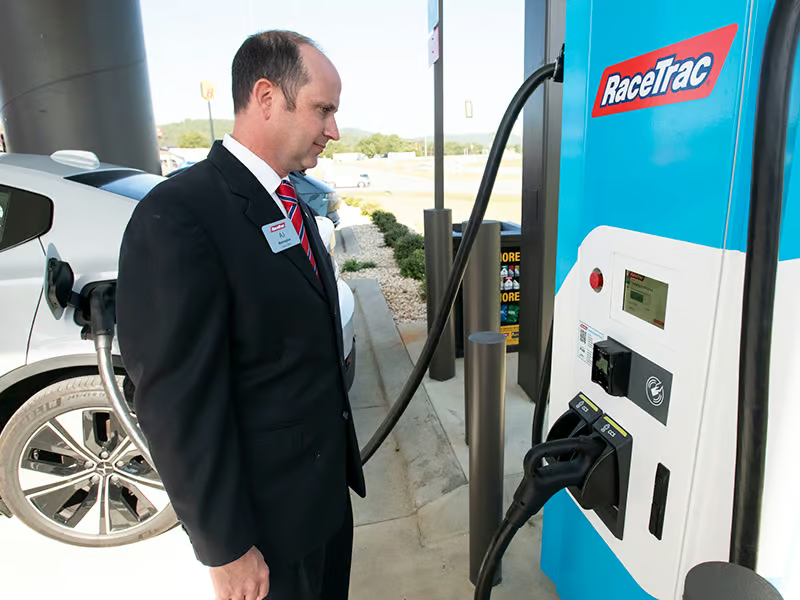
NATSO President and CEO Lisa Mullings said that the truckstop and travel plaza industry has made significant investments in electric vehicle charging to meet growing demand for this alternative fuel. Locations would be forced to reconsider those investments if the government were to allow hand-picked vendors or utilities to sell fuel from an advantaged location on the Interstate right-of-way, she said. “Private businesses that continue to grapple with the tremendous effects of the Coronavirus pandemic will not be able to compete for customers with a government-sanctioned monopoly,” Mullings said.
NATSO earlier this year unveiled a partnership with ChargePoint to create a National Highway Charging Collaborative. The Collaborative will deploy charging at more than 4,000 travel plazas and fuel stops in the next decade to significantly increase access to charging as EV adoption accelerates.
[ChargePoint and NATSO Launch Collaborative to Expand EV Charging Along Nation’s Highways]
Surface transportation law is set to expire in Sept. 2020. A major infrastructure package is viewed by some as a means of kick-starting the economy.
The Senate Enviornment and Public Works Committee released its version of a highway bill last summer.
Among its provisions, S. 2302 featured a first-ever Title on climate change. The bill would authorize $10.8 billion over five years for addressing climate issues. This includes establishing a grant program funded at $1 billion over five years for states and localities to build alternative fuel corridors, including electric vehicle charging infrastructure and natural gas refueling stations along designated highway corridors.
NATSO continues to work diligently to ensure that its members will have maximum access to the alternative fuel infrastructure grant money and that there will be no refueling stations at rest areas.
[Senate EPW Committee Passes Surface Transportation Bill]

Subscribe to Updates
The NATSO Foundation and NATSO provide a breadth of information created to strengthen travel plazas’ ability to meet the needs of the traveling public in an age of disruption. This includes knowledge filled blog posts, articles and publications. If you would like to receive a digest of blog post and articles directly in your inbox, please provide your name, email and the frequency of the updates you want to receive the email digest.